Language, Media, and Circulation

Andrew J. Strathern

Andrew Strathern received his Ph.D from Cambridge University and is an internationally recognized scholar and social anthropologist with a wide range of interests, including the analysis of political and economic systems, kinship theories, social change, religion and ritual, symbolism, ethnicity, legal anthropology, conflict and violence, the anthropology of the body, and the cross-cultural study of medical systems.

He has carried out long-term fieldwork in the Pacific (especially Papua New Guinea), Asia (especially Taiwan), and Europe (with a focus on Ireland and Scotland) and continues an active research and publication program in these global arenas as well as others. He also conducts research in and teaches on contemporary anthropological theory, linguistic anthropology, and linguistic and social issues in Europe and globally.

For many years he has collaborated with Dr. Pamela J.Stewart pamjan@pitt.edu and they have published widely on their findings. They are frequently invited international lecturers, discussing their current theoretical perspectives. Several of Strathern and Stewart’s recently published books are “Peace-Making and the Imagination” (Strathern and Stewart, 2011); “Ritual: Key Concepts in Religion” (Stewart and Strathern, 2014); and “Working in the Field: Anthropological Experiences across the World” (Stewart and Strathern, 2014).  Their research work in the Pacific, Asia, and Europe feeds into their Disaster Anthropology project on global climatic change, natural disasters, and human-produced disasters.  They are experts in Ritual Studies; Peace and Conflict Studies; Healing and the Body; and they have developed the Pitt in the Pacific Program with the University of Pittsburgh’s Study Abroad Office.  They work with Material Culture and conduct museum studies around the world.

Research Description

Andrew Strathern and Pamela J. Stewart are a husband and wife research team who have published over 50 books and hundreds of articles on their fieldwork. They have been conducting research (fieldwork and archival work) in Europe for over two decades, focusing on work in Scotland, Ireland, and on the European Union. Their work has included aspects of the study of Scots as a minority language and its Ulster-Scots variant within County Donegal, Republic of Ireland, and in Northern Ireland, and also cross-border relations between the Republic and Northern Ireland as well as issues of devolution within the United Kingdom. They have also been working on Scottish Diaspora Studies, relating to Western Australia, New Zealand, and the United States. A further dimension of their work relates to Heritage Studies in general and the contesting contexts in which the idea of heritage is deployed.  They are the co-editors of the "European Anthropology" Series.  They have also published many books and articles on their fieldwork in Papua New Guinea, Taiwan, Ireland and Scotland.

They are the Co-editors of Journal of Ritual Studies (also see the Journal's Facebook Page!), the Ritual Studies Monograph Series  and the Ethnographic Studies in Medical Anthropology and the European Anthropology Series with Carolina Academic Press. They Co-Edit the Series Anthropology and Cultural History in Asia and the Indo-Pacific for Routledge Publishing and the Series The Palgrave Studies in Disaster Anthropology for Palgrave Publishing. More about Research can be found on our Personal Website

Personhood in Melanesia

Arrow talk (el ik) is a genre of political oratory among the Melpa-speaking people of Mount Hagen in the Western Highlands Province of Papua New Guinea. It is practiced at the end of political events to express how history has crystallized into a state of transactional play between participants in the exchanges that constitute the event, including the sense of the event as a transition between other events and any suggestions of contradictions involved in these transactions.

Strathern, Andrew and Pamela J. Stewart
2000 Arrow Talk: Transaction, Transition, and Contradiction in New Guinea Highlands History. Kent State University Press, p.1.

A whole genre of vampire films designed for viewing by people in Europe and America taps into the same concerns as are exhibited in African contexts today. In general, these phenomena force us to recognize the final demise of the myth that modernity is based on the "triumph of rationality" in human affairs. Witchcraft ideas are themselves rational if we view them as logics of explanation. At the same time, they draw their power from fantasies of guilt and desire that arise from sources that could be labeled as "irrational."

Stewart, Pamela J. and Andrew Strathern
2003 Witchcraft, Sorcery, Rumors and Gossip. Cambridge University Press, pp. 91-2.
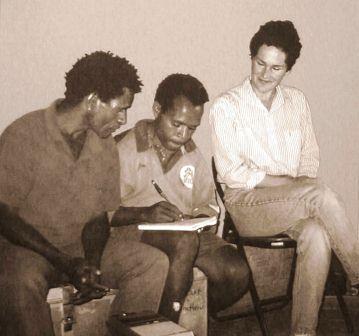
Each narrator tends to have an overall way of achieving a presentation of self corresponding to what Caroline Barros (1998) has called the "autobiographical persona." Like personhood, persona is the overall self-characterization that the narrator is attempting to project through the narrative process.

Stewart, Pamela J. and Andrew Strathern
2000 Introduction. In Identity Work: Constructing Pacific Lives,
edited by Pamela J. Stewart and Andrew Strathern. University of Pittsburgh Press, p. 5.
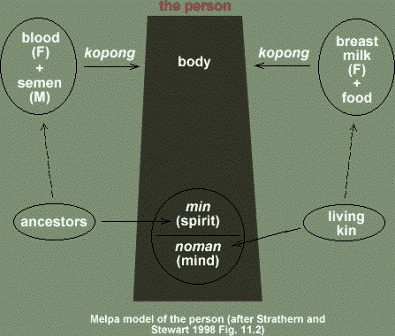
The min (spirit) comes directly from the ancestors, entering into the body during gestation, while noman (mind) develops after birth through the socializing influences of kin and primarily through the ability to speak. The person is therefore a complex amalgam of substances and influence.

Strathern, Andrew and Pamela J. Stewart
1998 Melpa and Nuer ideas of life and death: the rebirth of a comparison. In Bodies and Persons: Comparative Perspectives from Africa and Melanesia, edited by M. Lambek and A. Strathern, Cambridge University, p. 236.
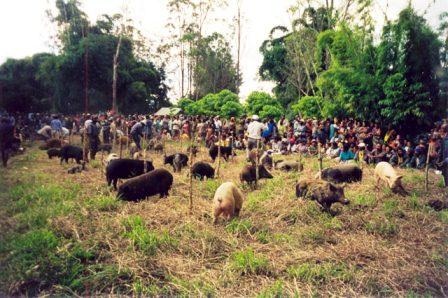
Pigs lined up and tethered to stakes for a compensation payment, Mount Hagen, Papua New Guinea, 1998. The occasion brought people from two different language groups together, since a killing had taken place between the Hagen and the Enga peoples, threatening the peace in the town of Mount Hagen itself, where immigrants from Enga live along with Hageners.

Round sweet potato beds in gardens at high altitude on the south road from Mt. Hagen to Tambul, Papua New Guinea, 1998. The sweet potato has been of prime importance in the social evolution of societies in the Highland region.

Large house built on stilts amid secondary regrowth in Hagu settlement among the Duna speakers of the Aluni Valley, Papua New Guinea, 1999. This house was being built for a young pastor of the Baptist church who is from the settlement, and its design reflects the status accorded to this new category of ritual leader.

Taiwan, Politics of Ritual

Two statues of the Deity Mazu sit in the midst of worshipers and tables covered with offerings to honor the Deity on the celebration of her birthday. Kuantu temple in Taipei, Taiwan, 2002.

In "the Mazu [Female Daoist Deity] complex in Taiwan...Mazu is seen as having great power over matters such as fertility and rain, and temples to her are ranked in terms of their putative founding dates and their consequent privileges of precedence in relation to one another...This relationship of precedence is marked by troupes of performers carrying statues of Mazu back to temples from which their own temple or its image originated, in order to renew their power and to show the performers' respect to the founding temples.
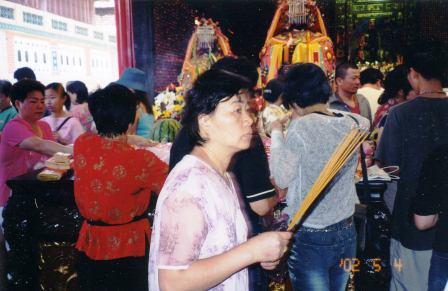
Worshiper burning incense at the Kuantu temple in Taipei, Taiwan on the celebration of Mazu's birth date.

Strathern, Andrew and Pamela J. Stewart
2003 Divisions of power: rituals in time and space among the Hagen and Duna peoples, Papua New Guinea. Taiwan Journal of Anthropology 1(1)51-76.
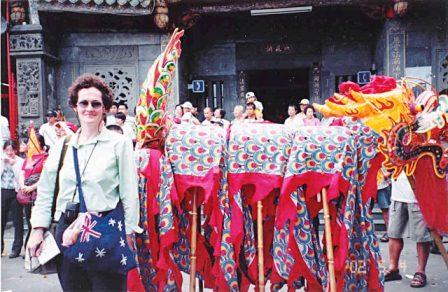
Dr. Pamela J. Stewart stands next to a resting dragon puppet that has just completed a dragon dance through the control of a local temple worship performance troupe. The location is the Kuantu temple, Taipei, Taiwan, 2002. The celebration was to mark the birthday of the Deity Mazu.

Prof. Andrew Strathern (A.W. Mellon Professor of Anthropology, U. of Pittsburgh) stands next to a newly constructed, privately funded, temple dedicated to the Earth God. He holds a fruit that a local worshiper shared with him after the worshiper prayed to the Deity at this temple, 2002. This temple is near to the Institute of Ethnology, where Prof. Strathern and Dr. Stewart are affiliated when they work in Taiwan. Through the Institute of Ethnology they are also studying aspects of historical change, cultural revival movements, and conversion to Christianity among the indigenous Austronesian speaking peoples of Taiwan with special reference to the Paiwan area.

Curing and Healing
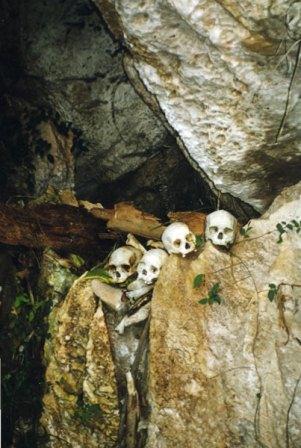
In the past, after a corpse had been exposed for the requisite number of days on a platform, the remains (bones) of the corpse would be removed and placed in a cave which would serve as the burial vault and permanent repository for them. This site was considered to be the home for the spirit, tini, of the dead person and had to be taken care of by the kin of the deceased.

Strathern, Andrew and Pamela Stewart
2010 (2nd ed.) Curing and Healing: Medical Anthropology in Global Perspective. Carolina Academic Press, p. 50.
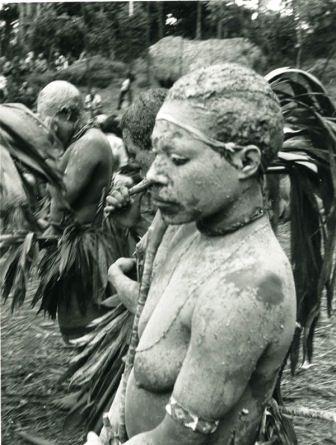
Female mourner among the Ndika people near Mount Hagen, early 1970s. Her hair, face, and body are plastered with white mourning clay, and she carries a cordyline switch. Earth paints are used to mark the body in particular ways (for healing, grief, or celebration, for example), and act to produce a kind of second skin on the person that intimately connects the human body to the ground.

Stewart, Pamela J. and Andrew Strathern, with contributions by Ien Courtens and Dianne van Oosterhout.
2001 Humors and Substances. Ideas of the Body in New Guinea. Bergin and Garvey, Westport.

Europe: Ethnicity, Language, and Identity
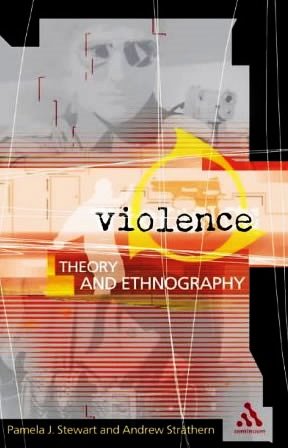
Violence: Theory and Ethnography explores the meanings and contexts in which violent actions occur. The authors develop further the concept of ‘the triangle of violence’ - the idea that violence is marked by the triangle between performers, victims, and witnesses – and the proposition that violence is also marked by contests regarding its legitimacy as a social act. Adopting an approach which looks at the negotiated and contingent nature of violent behavior, Pamela J. Stewart and Andrew Strathern stress the powerful unacknowledged associations between ideas of revenge and concepts of justice. These theoretical perspectives are applied to in-depth case studies from Rwanda-Urundi, Sri Lanka and Northern Ireland. The authors also draw on extensive field experience in Papua New Guinea, using ethnographic detail to address broader issues of considerable global importance.

Stewart, Pamela J. and Andrew Strathern
2002 Violence: Theory and Ethnography. New York and London: Continuum Publishing for Athlone Press.

Scots influence and traditions show clearly in these kilted and bagpipe playing marchers at the Orange Order parade, Rossnowlagh, south-west County Donegal, 5 July 2003. The Rossnowlagh marches are known for being peaceful. Near the center of this group one man holds up a huge Lambeg drum, which he is playing.

Strathern, Andrews, Pamela J. Stewart, and Neil Whitehead (eds.)
2006 Terror and Violence: Imagination and the Unimaginable. London and Ann Arbor: Pluto Press.

Minorities and Memories: Survivals and Extinctions in Scotland and Western Europe explores historical expressions of identity in Scotland, based on fieldwork in the Lowlands of Scotland carried out during 1996-2000, mostly in the County of Ayrshire but including materials from all over Scotland. Particular chapters consider Wales and Northern Ireland (where the authors have also conducted research subsequently as well as in County Donegal, Republic of Ireland) in comparison to Scotland. The book continuously weaves together historical narrative with anthropological reflections and analyses, examining the issue of identities through the perspective of both disciplines. The St. Andrew’s flag or Saltire is a mark of the longstanding sense of national identity in Scotland.

Strathern, Andrew and Pamela J. Stewart
2001 Minorities and Memories: Survivals and Extinctions in Scotland and Western Europe. Durham, N.C.: Carolina Academic Press.

Courses

Ritual: Theories and Cases

This course will examine the broad range of theories on the topic of ritual, an arena of discussion which has long been central to anthropological analysis and has acquired further significance through its overlaps with psychology, history, cognitive studies, and religious studies. The course will utilize selections from the extensive literature on the topic, both historical and contemporary, and will be enhanced by use of audio-visual materials for discussion. Students will be encouraged to bring forward their own themes for discussion throughout the course. The course will be open to students from Anthropology, Religious Studies, Cultural Studies, and related disciplines. This course will be offered on a regular basis in Spring Term.

Contemporary Anthropological Theory

In the last twenty five years, significant theoretical shifts have occurred within cultural anthropology, leading to and beyond the so-called post-modernist approaches. There was first a decline of encompassing "grand theories," followed by a stress on local forms of knowledge and practice as the object of our investigations. Later there have been a series of attempts at reconstructive theorizing either generally or in specific arenas, for example, in political anthropology and in historical anthropology. This course will explore medical anthropology, cognition and culture, the anthropology of religion, gender and modernity, ecology and development studies, globalization, political economy, and practice theory, including theories of violence and assist students critically to evaluate some of these trends. Attention will be paid to current issues of globalization and the creation or assertion of new forms of identity, local and transnational, in geopolitical contexts; as well as to reconstructive theories in general, for example in the sphere of religion and ritual, and studies of “development” and NGOs, environmental issues and disaster studies, and theories in the area of economic anthropology and neo-liberalism, as well as classic exchange theory and ecology. Prerequisites: This course is for 2nd or 3rd year Anthropology graduate students and others interested.

Linguistics Core Course

Language, evolution, and prehistory, world languages. Survey of phonology and phonemics, morphemics, syntax, writing systems and spelling, ethnosemantics, and sociolinguistics. Language and culture, language and power, the Sapir-Whorf hypothesis, ethnoscience, ethnography of communication, and linguistic pragmatics and meta-pragmatic approaches. Oral history and Oral genres, including poetry and song in Papua New Guinea and elsewhere. Language and movements for indigeneity and nationalism. Language studies and Cultural Anthropology including structuralism, the significance of literacy, cognition and culture, kinship studies, Pidgins and Creoles, Lallans and Ulster-Scots, the politics of minority languages.

Medical Anthropology 2

This course offers a survey of selected topics in contemporary medical anthropology. Topics to be covered may include cross-cultural and biocultural approaches to the study of sickness and healing, critical approaches to the study of biomedicine, interpretive approaches to ethnomedical systems, meaning-centered approaches to understanding the experience of suffering and pain, and the social construction of illness and healing. Special topics investigated include the anthropology of the body and sexuality, and physician-patient communication. Other topics can be added in accordance with student interests.

Human Ecology

This course examines human ecological relations within the environment, paying special attention to the vital contemporary issues surrounding global climate change and its specific manifestations in local ethnographic cases, the vulnerability and precarity that is implicated by it, and in particular how environmental disasters are increasingly being generated and test the resilience and creativity of the populations that experience them, including all life-forms and the landscapes they create and depend on for their life processes.

Kinship and the Family

Kinship in all its historical and contemporary manifestations is a central and enduring topic in the social sciences, ranging from the formal studies of different kinship systems to the intersection of changing gender relations and the construction of ideas of personhood and identity in the post-industrial world. Kinship ties run through all arenas of human life, including politics, economics, and religion, and are vital to the processes of cultural transmission and radical changes in cultural adaptations.

Myth, Symbol and Ritual

Mythology and its symbolism and ritual enactments are vital parts of the lives of many peoples and enter into the struggles of indigenous populations around the world as they seek to recreate the relationship with the environment. Myth remains an important part of religious practices. In addition, myth appears in changing guises in the creation of national and transnational identities in contemporary global society, and mythical sensibilities rest on the human capacity to create and deploy symbols. This course covers and provides insights into the aesthetics and the generative capacity of symbols and how they emerge into mythological and ritual syndromes.

Pacific Cultures

Pacific cultures present us with a fascinating picture of variability and adaptive variation in different parts of the vast area of Oceania. Taking into account long-term patterns of change from archaeological records and the work of comparative linguists, and utilizing a rich range of materials from media sources, this course provides a unique conspectus of insights, drawing on long-term field research, and aims to portray also the charm of these vibrant cultures and their contemporary struggles with problems of modernization and ecological challenges.


Pamela J. Stewart

Dr. Pamela J. Stewart (Strathern) is a research scholar with experience of working and living in the Pacific (special focus on Papua New Guinea), Asia (focused on Taiwan), and Europe (focused on Scotland and Ireland, also on the European Union).  Together with Prof. Andrew Strathern, over 50 books and hundreds of articles have been published demonstrating their broad interests in global issues, utilizing their cross-cultural linguistic skills, a powerful comparative and interdisciplinary approach, and an engaged ethnographic gaze.  Current research and writing is on the topics of Political Peace-making and Global Disaster Anthropology Studies.  

Research Description

http://www.StewartStrathern.pitt.edu/
http://www.pitt.edu/~strather/sandspublicat.htm

Gabriella Lukacs

I am a media anthropologist whose research focuses on Japan and Hungary. I take a political-economic approach to my research on analog and digital media, but I also derive inspiration from theories of infrastructure to think about materiality beyond its Marxist conceptualization as economic structures that set events in motion. I am the author of three books. Scripted Affects, Branded Selves: Television, Subjectivity, and Capitalism in 1990s Japan (Duke University Press 2010) analyzes how gender structures labor relations in the production of television programs and how these power relations shape the content of primetime entertainment in Japan. Invisibility by Design: Women and Work in Japan’s Digital Economy (Duke University Press 2020) examines how venture capitalists built the digital economy in Japan by harnessing young women’s pursuit of DIY careers. Finally, The Left of Hope: Media Activism in Illiberal Hungary (forthcoming from Cornell University Press) investigates how women and LGBTQIA+ activists harness analog and digital media to fight illiberal authoritarianism, which was consolidated in Hungary based on gender-based exclusion. I am currently developing two new book projects about low-birth society in Japan and Hungary. The first is tentatively titled Techno-Utopian Responses to the End of Familial Productivism in Japan, while the second is entitled Family-Friendly Hungary: Grassroots Pronatalism and Reproductive Justice Activism.

Research Description

My first book, Scripted Affects, Branded Selves: Television, Subjectivity, and Capitalism in 1990s Japan (Duke University Press, 2010), analyzes the development of a new primetime serial called “trendy drama” as the Japanese television industry’s ingenious response to developments in digital media technologies and concomitant market fragmentation. Integrating a political-economic analysis of television production with reception research, the book suggests that the trendy drama marked a shift in the Japanese television industry from offering story-driven entertainment (signification) to producing lifestyle-oriented programming (affect). It argues that by capitalizing on the semantic fluidity of the notion of lifestyle, commercial television networks were capable of uniting viewers into new affective alliances that, in turn, helped them bury anxieties over changing class relations in the wake of the prolonged economic recession.


Introduction is available here: 

https://www.dukeupress.edu/Assets/PubMaterials/978-1-4780-0648-0_601.pdf

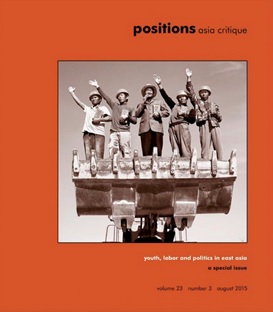
I also edited a special issue for Positions: Asia Critique titled Youth, Labor, and Politics in East Asia that investigates youth unemployment and underemployment—a prominent effect of the deregulation of national economies during the 1990s and 2000s in the region. As opposed to understanding youth unemployment and underemployment as social anomalies, this volume analyzes these trends as the new faces of labor. The contributors ask what it means for youth to become part of the workforce in a context in which young people are encouraged to think about work as a source of fulfillment, while the employment available to them is increasingly precarious.  

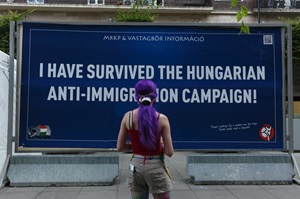
My most recent book, The Left of Hope: Media Activism in Illiberal Hungary, which is forthcoming from Cornell University Press, examines how Orbán Viktor’s Fidesz-KDNP government harnesses analog media to cement illiberalism in Hungary, and how the opposition engages digital media to fight illiberalism and rebuild the commons Orbán’s government enclosed or devastated. The manuscript documents how women and LGBTQIA+ activists have spearheaded anti-government activism in post-2010 Hungary, when the Fidesz-KDNP party coalition rose to power. The genres of media activism I analyze include: counter-billboard projects, which produce new political commons by calling out the government for its racist anti-immigration propaganda; street art, which gives visibility to the ways that social exclusion is infrastructurally reproduced; Internet memes, which enable women to enter the political domain and fight its patriarchal culture; independent theater, which fosters new cultural commons by reclaiming the category of “national culture” from an ethnonationalist government; and political podcasters, who innovate new models of community-funded media that also redefine the meaning of “public” in public service media. These case studies demonstrate that when one type of commons is produced, the idea of commoning is more easily transferred to other areas. In dialogue with materialist approaches to the commons, this manuscript develops the notion of commoning as a political strategy to build more inclusive communities in contexts in which far-right parties forge a sense of collectivity based on acts of exclusion.

I also started working on a fourth book project tentatively titled Techno-Utopian Responses to the End of Familial Productivism in Japan, which will theorize the end of what I conceptualize as familial productivism and investigate how the technology sector has responded to young people’s tendency to forgo marriage and childbirth in Japan. It investigates the technology sector (software and robotics developers) that design AI-driven smart-home devices (Gatebox), robotic companions (Aibo, Lovot), and dating apps for young people who live alone. What interests me in these case studies is the idea of social engineering via processes of capital accumulation. I will examine how the technology sector responds to demographic trends such as declining marriages and birthrates, and how technologists shape these trends by promoting their own technology-informed ideas about the future of Japan, its economy, and society.


My fifth book, Family-Friendly Hungary: Grassroots Pronatalism and Reproductive Justice Activism, project investigates the relationship between pronatalism and illiberalism in Hungary. It starts from the premise that pronatalism is not a top-down ideology that a government imposes on a defiant population. It examines support for and contestation of pronatalism at the grassroots level. Specifically, I will explore pro-life interest groups and gender conservatism among young Hungarians who would like to have more children than they can support. I will also interview young Hungarians who opt out of establishing families, and feminist NGOs that address the adverse effects of pronatalism.

Courses

Japanese Society

Undergraduate Lecture. This course introduces students to cultural practices and social institutions in postwar and contemporary Japan. It will give students a range of different exposures—using scholarly books, essays, and film to look at various conditions and aspects of Japanese culture and everyday life: high economic growth, middle class society, recession, social precarity, gender relations, education, consumer culture, and popular culture. We will examine discussions about the uniqueness and homogeneity of Japanese culture and ask what compels and shapes these ideas and how they are confirmed or contested in contemporary Japan. The special focus of this course is media culture (anime, otaku subculture, and Internet culture). We will discuss media culture in Japan and examine the reasons for its popularity abroad.

Gender and Globalization

Gender is a key structuring principle of difference and inequality in society, while globalization is a condition characterized by time-space compression and expanding connections across national boundaries. Globalization emerged out of such (and often violent) practices of contact as capitalism, colonialism, socialism, the Cold War, and neoliberalism. This course will explore the intersection of gender and globalization asking how gender shapes processes of globalization and how the role of gender is shifting as national regulatory systems no longer control what is “normative” in the contexts of gender roles and gendered division of labor. This course will examine various facets of the relationship between gender and globalization in such contexts as cross-border marriages, sex and colonialism, state violence, decoloniality, socialist welfare states, labor migration, the global sex industry, digital labor, and political activism that critically reflects on the role of globalization in intensifying gender discrimination both locally and globally.

Cybercultures

Undergraduate Seminar. In this course, we will draw on scholarly essays, journalism, documentaries, and TED lectures to discuss whether the architecture of the Internet is designed to foster more equitable communities, new opportunities to earn a living, freedom, and creativity. We will discuss various forms of hacking as key terrains where battles over the regulation of the Internet and struggles over intellectual property rights are waged. We will learn about surveillance capitalism, the platform economy, and data mining—a corporate practice that extracts value by transforming into data-commodities the traces we leave behind in cyberspace. By reading about entrepreneurial individuals who develop DIY careers in the digital economy and by considering how the Internet operates as an apparatus that captures unpaid labor, we will explore how digital technologies transform the world of work. To understand the ways in which digital media are conducive to the formation of new communities and the ways in which these communities enable individuals to improve their status in society, we will end the semester by discussing influencer culture.

Gender and Work in Cross-Cultural Perspective

This course inquires why we find it difficult to abandon deep-seated beliefs that men and women are not equally suited to pursue certain professions. We ask whether women belong in the army, the cockpits of airplanes and space shuttles, or whether men make good nurses and babysitters. In this course, we will read scholarly texts and watch documentary films to analyze the relationship between gender and work in various social contexts. We will ask how the realm of work operates as a site where gender differences and hierarchies are reinforced. We will examine how our beliefs about gender-appropriate occupational identities are culturally conditioned and how employers perpetuate gender biases in their hiring practices as they prioritize growth and profit over ideals of gender equity. We will read about flight attendants who were able to negotiate less sexist weight standards only in 1991, women in factories who are hired for their nimble fingers, sex workers, hostesses, hosts, and exotic dancers who are expected to perform gender at work. This class takes a cross-cultural perspective in analyzing the relationship between gender and work. We will ask how neoliberal globalization intersects with local gender divisions of labor in diverse social contexts.

Precarity and Politics

Graduate Seminar. Crisis seems to have become the normalized condition in which we live our lives and make sense of the world around us. Each new iteration of this condition, caused by financial meltdowns, wars, natural disasters, and recently the Covid-19 pandemic, further cement our perception that crisis has become permanent. This perception is further fueled by neoliberal globalization that builds on what Naomi Klein conceptualized as disaster capitalism. Governments that adopt neoliberal economic policies, Klein notes, tend to exploit crises to introduce structural adjustment plans during times when populations are too beaten down to mount an efficient opposition. By doing so, neoliberalism intensifies our sense of crisis as it grinds down our sense of security. Whereas critical scholarship on neoliberalism focus on the role of the economy in generating conditions of precarity, in recent years, scholars also started examining the social lives and cultures of this condition. Furthermore, they began exploring how conditions of precarity give us hope and galvanize our desire to reform our lives, reach out to others, and build new communities. This course will introduce students to theories and ethnographies of precarity, as well as works that analyze transformations in the ways we participate in the political domain to fight locally specific conditions of precarity.

Gender and the State

Graduate Seminar. This course will introduce students to scholarship that theorizes the increasingly complex ways in which the state harnesses gender to cement its political, economic, and cultural legitimacy. We will discuss such topics as pronatalism and reproductive rights as new centers of gravity in conservative forms of governance, low birth society, the state’s involvement in regulating sexuality including commercial sex, alternative economic practices that are often spearheaded by women, women’s role in maintaining various forms of the commons, women’s systemic mobilization to various forms of reproductive labor, and the reproductive justice movement. The course inquires whether we could think of declining fertility rates in the advanced capitalist world as both an effect and an expression of an enduring crisis in familial productivism, the social factory, and the prevalent system of wage labor, which no longer serves as a fair mechanism of redistribution. We will examine governmental responses to these developments and feminist strategies to intervene in them. We will discuss how invisible labor is increasingly integrated into formal processes of capitalist accumulation via extracting surplus value from the unremunerated labor of communication and sociality in the service industries or “the labor of love” in the context of familial reproduction. We will explore what forms of feminist activism and feminist politics emerge in the wake of chronic care deficit and women’s growing unwillingness to assume the responsibility for filling in the void created by the neoliberal dismantling of the welfare state and, more recently, failures in the delivery of public services in the aftermath of the COVID-19 pandemic.


Publications

The Left of Hope: Media Activism in Illiberal Hungary (forthcoming from Cornell University Press)

“The Affective Labor of Commoning: Street Art in Illiberal Hungary,” Anthropology of Work Review, 45(1): 14-28 (2024). http://doi.org/10.1111/awr.12266

“The Gender of the Meme: Women and Protest Media in Populist Hungary,” Feminist Media Studies, 23(3): 803-818 (2022). https://doi.org/10.1080/14680777.2021.2018007

“Internet Memes as Protest Media in Populist Hungary,” Visual Anthropology Review, 37(1): 52-76 (2021). https://doi.org/10.1111/var.12232

Lukacs, G. (2020) Invisibility by Design: Women and Labor in Japan's Digital Economy. Durham, N.C.: Duke University Press.

Lukacs, G. ed. (2015) Youth, Labor, and Politics in East Asia, Positions: Asia Critique, Volume 23, Issue 3.

Lukacs, G. (2015) “Cool Japan, Soft Power, and Cultural Globalization,” in Towards New Humanities in the Era of Ubiquitous Media, Ishida Hidetaka, Yoshimi Shunya, and Mike Featherstone, eds. Tokyo: University of Tokyo Press, 195-218 (in Japanese). 

Lukacs, G. (2015) “Unraveling Visions: Women’s Photography in Recessionary Japan,” Boundary 2, vol. 42, no. 3, 171-184.

Lukacs, G. (2015) “Labor Games: Youth, Work, and Politics in East Asia,” Positions: Asia Critique, Volume 23, Issue 3, 487-513

Lukacs, G. (2015) “The Labor of Cute: Net Idols, Cute Culture, and the Digital Economy in Contemporary Japan,” Positions: Asia Critique, Volume 23, Issue 3, 381-409.

Lukacs, G. (2013) “Dreamwork: Cell Phone Novelists, Labor, and Politics in Contemporary Japan,” Cultural Anthropology, 28(1):44-64.

Lukacs, G. (2012) “Workplace Dramas and Labor Fantasies in 1990s Japan,” in Global Futures in East Asia, Ann Anagnost, Andrea Arai, and Hai Ren, eds. Stanford University Press, 222-247.

Lukacs, G. (2010) “Iron Chef Around the World: Japanese Food Television, Soft Power, and Cultural Globalization,” International Journal of Cultural Studies Volume 13(4): 409-426.

Lukacs, G. (2010) “Dream Labor in Dream Factory: Japanese Television in the Era of Market Fragmentation,” in Television, Japan, Globalization, Mitsuhiro Yoshimoto, Eva Tsai, and JungBong Choi, eds. Ann Arbor: The University of Michigan Press, 173-194.

Lukacs, G. (2010) Scripted Affects, Branded Selves: Television, Subjectivity, and Capitalism in 1990s Japan. Durham, N.C.: Duke University Press.

Robert M. Hayden

Robert Hayden (J.D., Ph.D.) is an anthropologist of law and politics. His primary research for more than three decades has focused on the Balkans, but has also done fieldwork in India (1970s, 1992, 2013) and among the Seneca Iroquois of New York State (1970s). Following ethnographic research on Yugoslav socialism from 1981-89, he did extensive work on issues of violence, nationalism, constitutionalism and state reconstruction in the formerly Yugoslav space, as well as on transitional justice issues stemming from the Yugoslav wars. From 2007-2013 Professor Hayden headed Antagonistic Tolerance: An International & Interdisciplinary Project on Competitive Sharing of Religious Sites, which developed and analyzed, variously, ethnographic, historical and archaeological data from Bosnia, Bulgaria, India, Mexico, Peru, Portugal and Turkey. His new research stemming from this project include studies of sufi/ dervish orders in post-imperial settings, and the (re)construction of religious sites to mark competing national territorial claims in Bosnia since the end of the war there.

Courses

Violence, Tolerance and Dominance at Shared Religious Sites

Undergraduate Seminar. This course analyzes “antagonistic tolerance,” or contested sharing of religious sites. Worldwide, and widely throughout history, sacred sites have been shared, and sometimes contested, by members of different religious communities. Long periods of peaceful interaction and even religious syncretism may be punctuated by periods of violence, and the physical transformation of the shared sites. This course examines this dynamic by looking at case studies drawn from Europe (Bulgaria, Portugal, Turkey), Asia (India) and Latin America (the Inka Empire). The approach draws on both cultural anthropology and archeology, and some of the case studies are based on recent ethnography, others on ethnohistorical data, others still on archeological data. The cases have been developed in the course of a large-scale comparative research project by the instructor and an international team of scholars, and the course will work through their initial efforts at drawing conclusions from this ongoing project. The course will thus be an introduction to an ongoing, complex project in anthropology, including both archeology and cultural anthropology. Students will be encouraged to think about how the general model might be applicable in other world regions. Requirements: There will be a midterm examination and a seminar paper, the latter due at the end of the term. Since this is a new area of research, class attendance and participation are very important. No prerequisites: There are no formal pre-requisites, but students should have had some basic courses in anthropology (cultural and/ or archeology), history, or other social sciences

Cultures and Societies of Eastern Europe

This course offers an introduction to the societies of Eastern Europe with an accent on the cultural history of the region during the modern epoch (Russian/USSR excluded). The course begins with an examination of the various intellectual inventions of Eastern Europe, as well as of the widely differing political consequences of such exercises in “philosophical geography” for various parts of the region. Local versions of the “processes of civilization” and their social consequences will be discussed, as well as the reception of modern ideas and ideologies (and various forms of counter-reaction to such influences). The rapidly diversifying strategies of principal social actors, the dynamics of such cultural processes, the new roles of ideologies like nationalism, and the resulting social divides, political cleavages and “culture wars” will be considered. Attention will also be given to issues of everyday-life, popular culture, and the diversification of individual lifestyles. The final grade will be based on mid-term and final exams and on class participation. Students will have the option of writing an essay on a theme or film presented in class, in place of the midterm exam.

Cultures & Society of India

This course focuses on contemporary Indian social and cultural formations, after reviewing some very basic cultural history and geography, and the development of the country and those formations since independence. Since independence in 1947, India has developed from an overwhelmingly agricultural and traditional society that was not able to grow enough food for its 325 million population, to an increasingly urban, developed society of 1.2 billion that exports food along with a wide range of products and services, including cutting-edge high-tech ones. The Indian middle class is growing rapidly. India is also the world’s largest democracy, and has dealt, very substantially though not in full measure (to cite first Prime Minister Nehru) with the complexities of a multi-religious, multi-ethnic, and in all other ways extraordinarily diverse societyTopics to be covered include the interactions of religious communities in a secular state; caste, class, gender and other principles of social distinction; regional identities; socio-economic development; and the intertwining of all of these factors in democratic (or at least electoral) politics.

Ethno-National Violence

Undergraduate seminar.  Violence between members of different ethnic and religious communities within what had been nation states is increasingly common: Syria, Afghanistan, Iraq, Ukraine, to name just a few current cases.  Yet such violence is not new – in the past century alone, it has occurred in many countries throughout the world.  This course examines the logic and frequent tactics of such violence in Europe (Greece/ Turkey 1923, Cyprus 1974, Yugoslavia 1941-45 and 1991-95), South Asia (India/ Pakistan 1947, India since then), and the Middle East (Israel/ Palestine; Syria) among others.  We will pay particular attention to links between religion and conflict, and to gendered patterns of violence.  Most readings are ethnographic, close analyses of cases; but comparative frameworks will also be developed.  I assume no special knowledge by students of any of the case studies before the course begins.  By the end of the course, students will have an understanding of contemporary cases of violence, and also of the common features of such violence in the modern period.